
What do you do when you need to make a decision? How do you know what makes your new hire tick? How do you know what gets under your own skin?

One of the easiest and definitely most fun ways to delve into both your motivations (more on that below) is to play Moving Motivators!
Invented by founder of Management 3.0, Jurgen Appelo, Moving Motivators is an exercise meant to help us reflect on motivation and how it affects organizational change.
The Moving Motivators exercise is based on ten motivators, which Jurgen derived from the works of Daniel Pink, Steven Reiss, and Edward Deci. These ten motivators are either intrinsic, extrinsic, or
a bit of both.
But before we delve into those desires let’s first define the difference between
Intrinsic and extrinsic motivation
What is intrinsic motivation? According to Jurgen this is defined as people’s innate desires to do well and to have an eagerness for self-control and self-direction in accomplishing objectives. Successful intrinsic motivation is the result of the fulfillment of basic desires
What is extrinsic motivation? External rewards such as payments, bonuses or promotions
Now that we’re clear on that, let’s have a look at the ten motivations. Keep in mind that while there are explanations for each one, the most important thing is that each motivator makes sense to you and to your team. Take a few minutes before starting to define what each motivator means to you.
Learn to play Moving Motivators at a Management 3.0 event! It’s part of the module Energize People: Motivation and Engagement
10 Motivations: CHAMPFROGS
The ten CHAMPFROGS motivators are either intrinsic, extrinsic, or a bit of both. The CHAMPFROGS model deals specifically with motivation in the context of work-life.
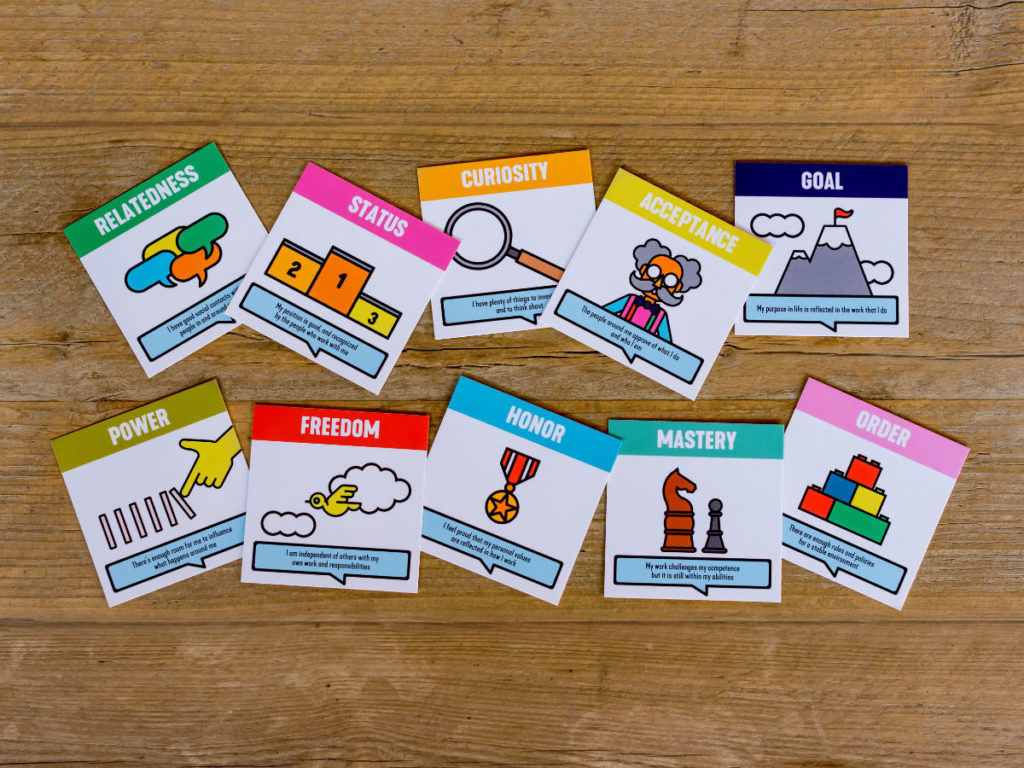
Curiosity: I have plenty of things to investigate and to think about
Honor: I feel proud that my personal values are reflected in how I work.
Acceptance: The people around me approve of what I do and who I am.
Mastery: My work challenges my competence but it is still within my abilities.
Power: There’s enough room for me to influence what happens around me.
Freedom: I am independent of others with my work and my responsibilities.
Relatedness: I have good social contacts with the people in my work.
Order: There are enough rules and policies for a stable environment.
Goal: My purpose in life is reflected in the work that I do.
Status: My position is good, and recognized by the people who work with me.

Now it’s time for the fun part. Playing the employee motivation game!
How to play Moving Motivators
Step One: Define which motivators are important to you. Place the cards in order from left (least important) to right (most important.)
Step Two: Discuss how change affects your motivators. For example: If you’re wondering if you should change jobs, which would mean moving to another city, learning a new skill and making all new friends, how does that affect what motivates you? It’ll most likely increase some motivators and decrease others. Move the cards up for a positive change and down for a negative one and then look at whether you have more cards up or down. This is a great way to help make decisions.
Step Three: Time for reflection and discussion. Talk to your teammates about which motivators are least and most important to them. This will give you better insight into what drives your colleagues and allow you to create stronger relationships and increase collaboration. Use it also as a tool to reflect and assess your own life decisions. When most of your important motivators go down or when the least important ones go up it might be time for reflection.
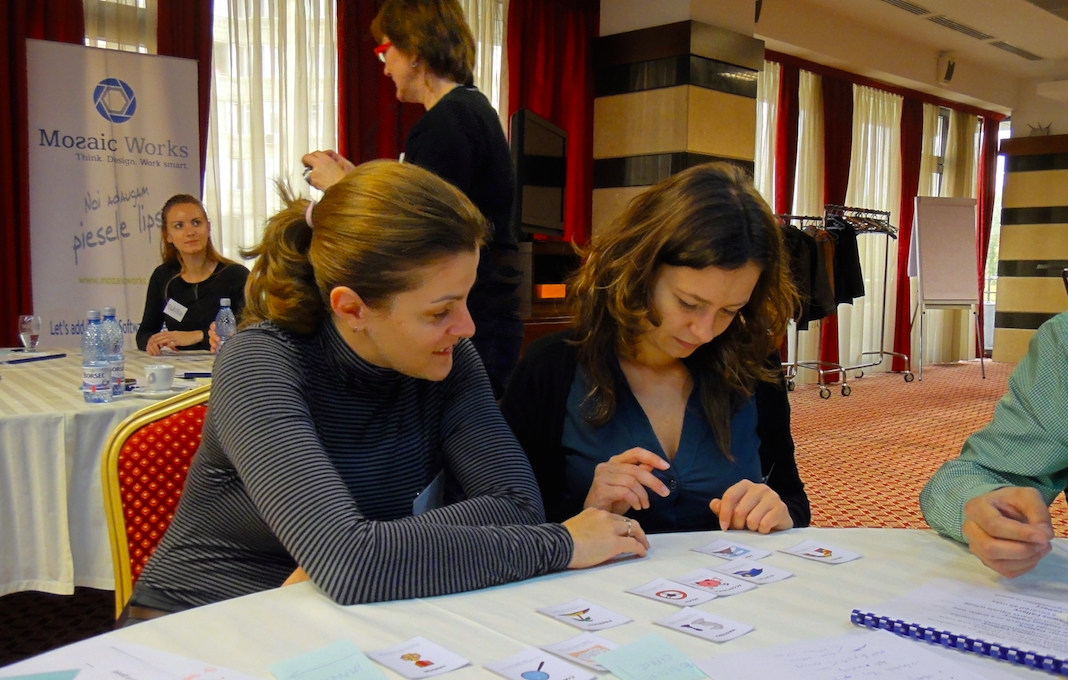
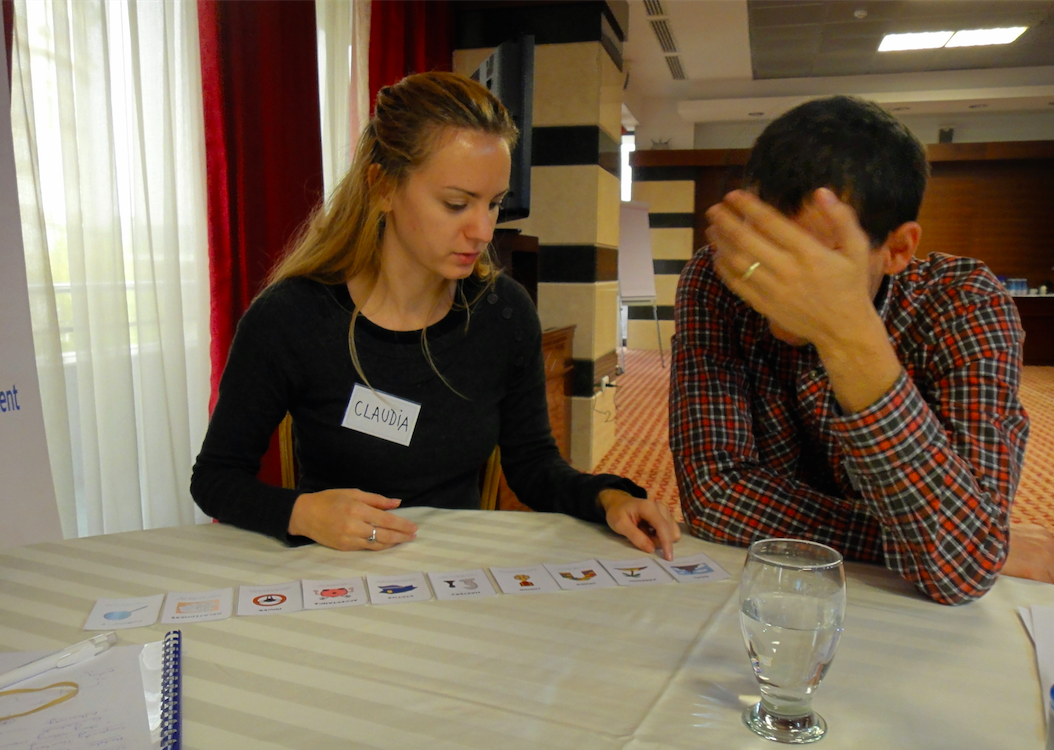
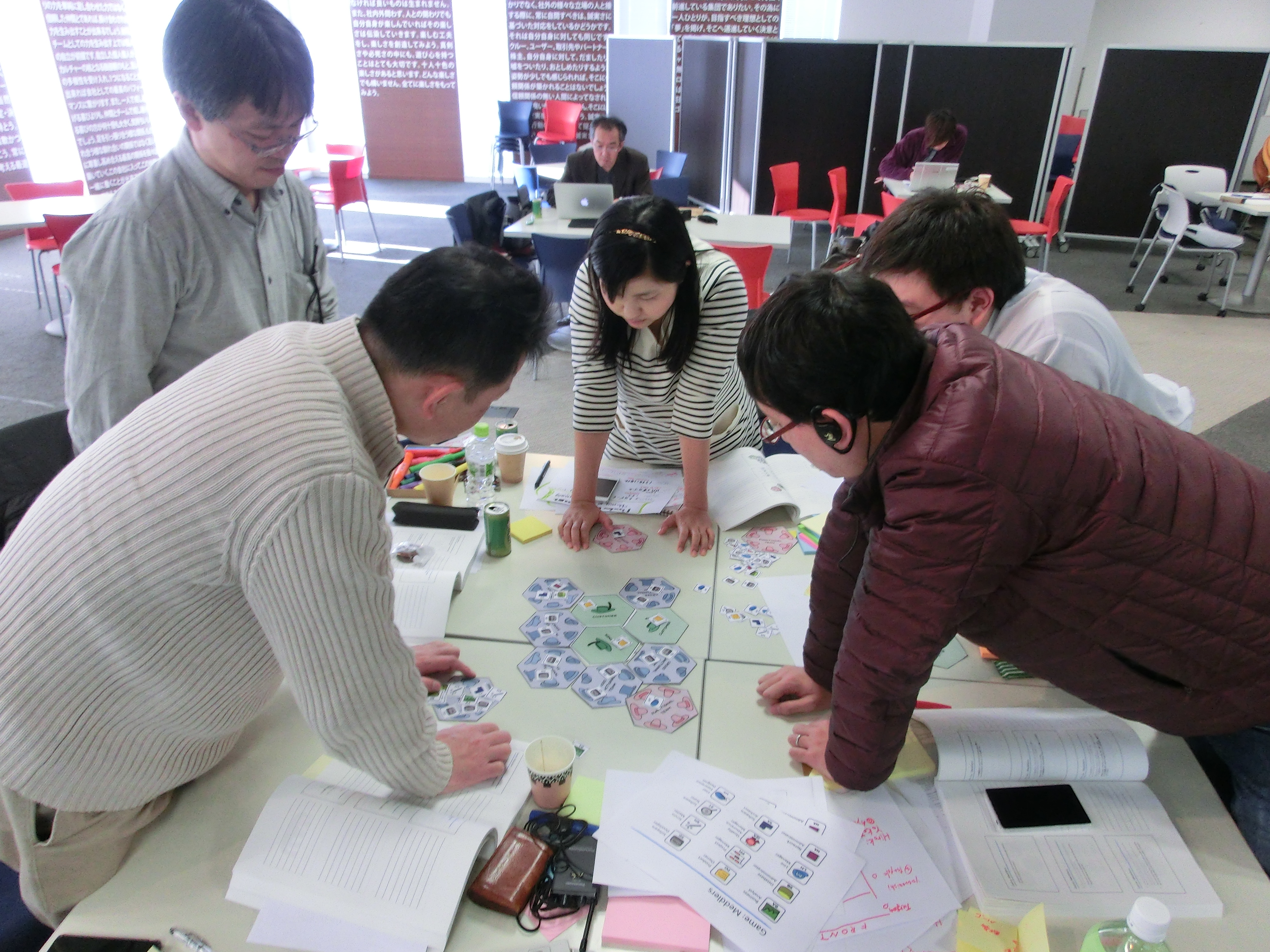
Photos: Dan Pop
I use this game to do a motivation reflection of my startup partner. Both of us explore and define in detail the real motivation for us to start the business. While before that, it is unclear, although both of us are willing to start the business and making funs from that. This is a very useful exercise.
an Agile coach, Shanghai China
Side note: When Moving Motivators was first developed it was used for team managers and for one-on-one sessions to learn more about employee motivation (what motivates their team members). It became so popular and useful that now it is used with whole teams, between start-up founders and even in personal relationships.
Buy your own deck of Moving Motivators cards today!
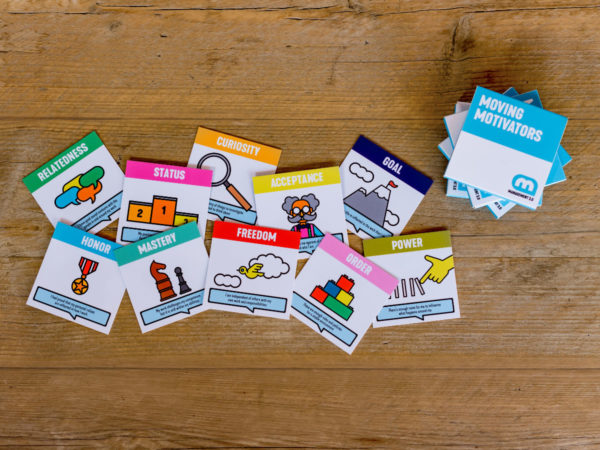
In our Management 3.0 shop Moving Motivators are available in English. If you require another language you can download them for free, print and cut yourself.
Currently the following languages and formats are available for download:
- English
- Czech
- German
- Spanish
- Finnish
- French
- Hungarian
- Italian
- Japanese
- Korean
- Dutch
- Polish
- Portuguese
- Russian
- Slovakian
- Swedish
- Turkish
- Ukrainian
- Vietnamese
Download Moving Motivators
Download the Moving Motivators Game to print and cut it yourself. You will be able to choose your language from a list you’ll receive after filling in your details and confirming your subscription to our mailing list. Please note: Re-selling is not permitted.
Moving Motivators Tips
Always plan to have a discussion after playing moving motivators. That’s where the most value is when it comes to finding out about employee motivation.
When playing moving motivators, it helps some people to think out loud by talking to a (silent) observer.
It helps some groups to start with a brief discussion of the 10 motivators to get a narrower understanding and interpretation of each.